Double Electric Range Oven


The benefits of a double oven range are undeniable. Whether you often find yourself cooking large meals for friends and family, or just want to roast a chicken and bake a cake at the same time, a double oven range—like our top pick, which is the Whirlpool WGE745C0FS (available at Best Buy for $1,499.99)—will have all the cooking space you need.
Luckily, we're experts when it comes to testing ovens of all types, and we've got your back if you're in the market to double down on your baking, roasting, and broiling capacity.
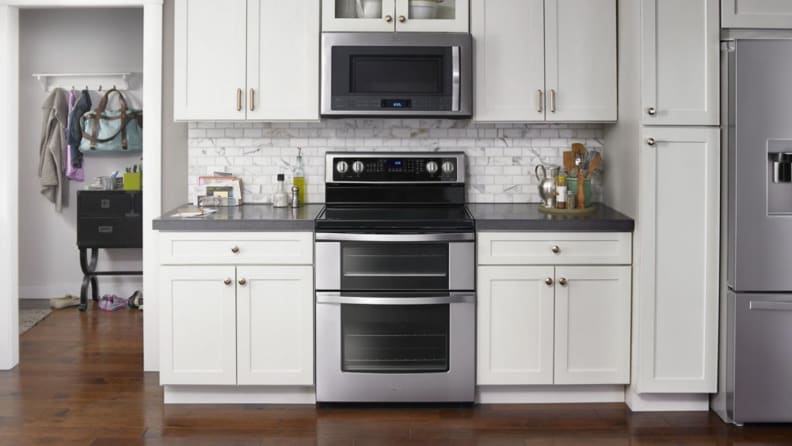
Credit: Whirlpool

The Whirlpool WGE745C0FS is the best electric range we've tested.
What You Should Know Before Buying a Double Oven Range
What Is a Double Oven Range?
This one is thankfully pretty self-explanatory. Instead of having a single oven compartment, these ranges have two separate oven compartments that are controlled separately. This design allows you to cook two items at different temperatures, or only heat up the smaller oven if that's all you need.
They're ideal for cooks who typically have to prepare multiple dishes at once, or cooks who make smaller meals that don't always require large oven space. Double oven ranges are also ideal for preparing large meals of multiple dishes that center around a turkey, roast, or long-cooking dish. You can set that in the larger section for a long, slow roast, and still have oven space to cook everything else at a different temperature.
What Are the Different Types of Ranges?
One of the main ways to differentiate ranges is by their fuel type: gas, electric, dual-fuel, and induction.
• Gas — Lower cooktop temperatures, faster water boiling than electric ranges, potential for uneven cooking/baking because of central flame location
• Electric — Higher cooktop temperatures, slower water boiling compared to gas and induction, more even cooking/baking because of heat distribution over coil
• Dual-fuel — Gas cooktop with an electric oven, which will give you faster water boiling times than an electric stove, but more even cooking/baking than a gas oven because of heat distribution over coil
• Induction — Super faster water boiling, very high and low cooktop temperatures, requires induction-compatible cookware, may require recipe modification
Depending on your cooking and baking priorities, as well as the way you learned to cook, one of these fuel types might be more appealing than the rest. One more thing to consider: dual-fuel and induction ranges can be more expensive than traditional gas and electric ranges, depending on the features and manufacturer.
What Is the Difference Between Convection and True Convection?
True Convection is an oven setting that includes installing an extra heating element and a fan in the oven. By adding an additional heating unit and fan that circulates the hot air, True Convection is great for ensuring that cookies or cakes baked on different racks will bake through at the same rate, rather than the cookies closest to the bottom heat source cooking faster than those on the rack higher up. If you don't see mention of "True Convection" or "European Convection", but do see the word "convection" in a range's specs, it means that the unit lacks an additional heating element, but does have a fan to circulate the hot air. While you don't get the full baking and cooking effect that you would with True Convection, the added heat circulation can cook or bake food more evenly than it would without a fan.
There are also ranges out there that do not offer convection options at all; these ovens aren't bad, it will just take more time to cook and bake food all the way through. If you're a frequent baker or cook, convection can be a great time saver, but your dinners won't suffer unduly without it.
What Is the Difference Between Slide-In and Freestanding Ranges?
In a nutshell, slide-in ranges are meant to sit flush with your countertops, while freestanding ranges can be placed anywhere there is a compatible electrical outlet. Freestanding ranges are finished on the sides, which may be exposed if they're not placed between cabinets, while slide-in ranges may not have finished sides because they're meant to be hidden.
Additionally, since slide-in ranges sit flush with your countertop, they're a bit easier to clean because they do not have a large lip around the edge. Freestanding ranges often have larger lips around the edge of the cooktop to corral any crumbs that would otherwise decorate your floor. Freestanding ranges also typically have a back-mounted control panel for the same reason.
While freestanding ranges will do fine in a slide-in arrangement, the reverse is less true. If your current cooking setup has the range sitting in a cabinet or countertop cutout, we recommend replacing that range with another slide-in range. Conversely, if your range stands alone in your kitchen, we'd recommend replacing it with another freestanding range to cut down on food debris spilling everywhere.
Should I Get a Front-Mounted Control Panel or Back-Mounted Control Panel?
As we mentioned earlier, most freestanding ranges have back-mounted controls, but some slide-in ranges do as well. Both arrangements have pros and cons; on the one hand, having back-mounted controls means you may have to reach over hot food to adjust the oven temperature. The controls are also far enough away that you would have difficulty hitting something on the control panel by accident.
On the other hand, front-mounted controls are easier to reach, but that convenience can turn against you if you brush up against a knob accidentally. Consider the ergonomics of using the range when it comes to picking a front- or back-mounted control panel.
How Many Burners Do I Need?
Depending on how much time you spend in the kitchen, it might be worth it to investigate in some extra options for your range. When it comes to the cooktop, anything above the standard four-burner setup is a bonus. Some ranges can have five, or even six burners; however, the more burners a range has, the more difficult it becomes to fit large pieces of cookware, such as a spaghetti pot and a frying pan, on their respective burners at the same time.
Sometimes, those extra burners are specialty burners are designed to accommodate special cookware such as a griddle or a wok; other burners are bridge burners that are meant to keep food warm without continuing to cook it.
Another possibility is to have a dual-ring burner, or a burner that includes a stronger heat source wrapped around a weaker heat source. That way, on a single burner, you can choose to use just the smaller heat source for lower temperatures, but you can add the stronger heat source if you need higher temperatures.
What Oven Features Do I Need?
As for extra oven features, they can include everything from accessories like special oven racks or a temperature probe to special cooking features like the aforementioned convection settings, fast preheat (which expedites the preheating process), bread proofing (where the oven settings are customized to activate yeast and make bread rise), steam cooking (where you pour water into a reservoir and gently cook something with the resulting steam), air fry mode (where you can expeditiously fry frozen and fresh foods, similar to an air fryer) and many, many more options.
More Articles You Might Enjoy
- The Best Gas Ranges
- The Best Electric Ranges
- 11 things you need to know before buying a kitchen range
- How to choose the right cooking appliances for a big family
Meet the testers

Kori Perten
Former Editor, Home & Outdoors
@Reviewedhome
Kori began her journalism career as a teenage fashion blogger and has enjoyed covering a wide variety of topics ever since. In her spare time, she's an amateur poet, avid reader, and gluten-free cake baker extraordinaire.

Jessica Teich
Former Editor
@jessicarteich
Jessica covered lifestyle and beyond at Reviewed. Her work has appeared in publications including The New York Times and The Boston Globe.

Madison Trapkin
Contributor
Madison covered all things cooking as the kitchen editor for Reviewed in 2021. Formerly the editor-in-chief of Culture Magazine, Madison is the founder of GRLSQUASH, a women's food, art, and culture journal. Her work has also appeared in The Boston Globe, Cherrybombe, Gather Journal, and more. She is passionate about pizza, aesthetic countertop appliances, and regularly watering her houseplants.
She holds a Bachelor's degree from the University of Georgia and a Master's of Liberal Arts in Gastronomy from Boston University.

Lily Hartman
Staff Writer, Search
Lily Hartman is a staff writer at Reviewed. In her free time, she enjoys hiking the White Mountains, running at the beach, and strength training at the gym.
Checking our work.
Our team is here for one purpose: to help you buy the best stuff and love what you own. Our writers, editors, and lab technicians obsess over the products we cover to make sure you're confident and satisfied. Have a different opinion about something we recommend? Email us and we'll compare notes.
Shoot us an email
Source: https://www.reviewed.com/ovens/best-right-now/best-double-oven-ranges
0 Response to "Double Electric Range Oven"
Post a Comment